Are You a Yoga Skeptic?

Science Lab

Image by Curious Expeditions

In my non-yoga related field of study, most participants fall pretty neatly into one of two camps.  They are either social scientists or they are humanist/interpretivists (some would say that critical approaches represent a third, but that’s an argument for another day).  Early in my academic life, I spent some time on social scientific work, even getting to coauthor a few publications from that perspective.  I pretty quickly decided that approach/world view just was not for me.  It wasn’t that I didn’t think it has things to say; it does.  It wasn’t that I didn’t see the utility or logic in such an approach; I did.  It just felt incomplete to me to study living beings totally at the level of science.  I felt like I was missing something crucial that could only be fully examined through looking at the diversity of individual experience rather than the ascertaining the common patterns.  So, all that to say that I don’t usually self-identify as a scientist and am often most drawn to non-scientific research when it comes to understanding the human experience.

Now and then, however, my inner scientist pokes her head around the corner and says, “Um, excuse me, but do you have some proof of that?”  I had this experience this week reading about Prana and yoga philosophy.  My inner scientist (or skeptic, you might say), does not much rebel at the idea of a universal connection or that we are all one.  Apparently, there is enough evidence for those to keep her quiet – or it’s a leap of faith she is willing to make.  The concept that breath is the root of everything in the body, that works for the science skeptic.  After all, without breath there is no life, so it seems somehow perfectly reasonable to go there.

This week in class we read and discussed prana, the nadis, chakras and so on, and the inner skeptic scientist ran right into the center of my brain and made her presence known.  Had the reading started first with prana and nadis, as we did in class, I think that might have happened more slowly.  Even the skeptic is ok with the idea that there is a life force in the body that cannot be reduced to the breath, or the nervous system, or the cardiovascular system.  It’s something else.  And with that accepted, the general notion of nadis also works – if there is an energy, then the idea of energy pathways is reasonable enough for the skeptic.  But, when I started reading for this week, I began with a chapter from Jivamukti Yoga by Sharon Gannon and David Life.  The first paragraph begins with a description of Kundalini (consciousness) coiled as a snake at the base of the spine, reading to ascend to cosmic consciousness through  the sushamna nadi (central energy channel).  Yeah, um, what?  My inner scientist skeptic started immediately getting antsy.  I think there may have been some pacing.  From there it headed into nadis and chakras and vayus and granthis and I think that my inner scientist may have begun holding her head and moaning slightly.  “Wait!  Where is the evidence?  How do you know there is a central channel with two channels wrapped around it?  Snake, what?  REALLY?  Chakras and granthis that cannot be seen?  Uh huh.”

It’s not that I can’t believe in something unseen (see me speaking of this part of self that I’m calling the inner scientist/skeptic?) but known though experience.  I think it’s that when I start thinking about the physical body and then combining that with talking about the metaphysical in ways that I have not really experienced, then somehow that part of what is “I” wants some evidence.  I want to see it or see that someone has.  I want to read some test results.  I guess I want proof.  Interesting from a humanist/interpretivist!

I don’t think this will be a stopper for me in these studies.  I just have to find a spot from which I can think about these ideas and examine their utility for being (after all, as I tell my students, the accuracy of your memories is not important at all – what is important is what they are doing for/to you today).  I just need to find a way to be with this knowledge that doesn’t make my inner scientist squeamish.  And, I think I can.   My nervousness about accepting as “fact” (or even more as dogma) what I have no experience of (including scientific ) has a lot to do with how uncomfortable I am with accepting religion, but when I embraced Buddhism as a philosophy built on experiential examination of being, it was all good and I became comfortable enough to say that I embrace Buddhist thought – in the understanding that Buddha said we shouldn’t accept this way of thinking about being as the absolute – we should always question and bring in what we have experienced.  So, this will be a part of my ongoing project in yoga.  How about you?  Do you have an inner scientist/skeptic and how does this impact your yoga practice?

I must say, people who think yoga is just “fuzzy stretching” are awfully confused ; )

Namaste,

L

Oh, Yogi! Who’s Zoomin’ Who?

In teacher training yesterday we considered the second of the Yamas (restraints), which is Satya – truth or non-lying.  Our conversation of Satya was quite interesting and I could think of many examples where I am not fully truthful (as I think we all can).  Often, for me, being untruthful occurs in an attempt to protect my face (the image I want to present to the world) or the face of others – more on that later.  So, I woke up today in the right frame of mind to think about Satya as I went through my day.

Image by CrystalGinger

Having gotten the kids up and off to school, I quickly hit a road block.  I have been having a flare-up of rheumatoid arthritis this week, because of a combination of a change in weather, hormonal shifts, and being off of two medications that I normally take.  The result is that my joints are very sore and feel simultaneously really tight and really loose (in a bad way).  The pain associated with this also causes nausea, compounded by a lovely little sinus issue, and I haven’t been eating much either.  So, the upshot is that I’m not feeling so hot.

The decision before me today was whether or not to attend a 9:30 Vinyasa class.  As I went through the rest of my morning leading up to the time when I really had to get ready, I was thinking about teacher training class the night before.  So, when time came to make a choice, I found myself in an interesting conundrum.  On the one hand, I could go to class – but then was I lying to myself about whether this was right for me and overdoing in a way that could be bad?  On the other hand, I could stay home and rest a bit before work – but then was I lying to myself about what I was capable of and not stretching my boundaries in the way needed for growth?  Hmm…  I went back and forth and back and forth and finally, as time got late, just put on my yoga outfit and headed out.  Great!

I would love to now tell you that this was absolutely the right decision and that the class helped me feel better.  But, I cannot tell a lie (ha!).  By 10 minutes in, I knew that this wasn’t working out.  I got through, spending a good amount of time in Child’s Pose or Adho Mukha Svanasana.  That’s ok, but even then, I was somewhere in between crying and yarking the entire class.  It just was so not pretty.  I couldn’t really concentrate on the poses because I was so busy concentrating on not physically falling apart.  And, as you might guess, there was no calm to be found.

So, great.  I made a choice in an effort to not lie, but it turned out that it wasn’t that simple.  How was I to know what choice to make?  I’m still not sure about that, but in reflecting on the whole situation, I am pretty sure that this all came down to an issue of Asmita (egoism or an attachment to a particular “self”).   I reduced the options I had to two in my mind (stay or go – might there have been another? – I think so) and then attempted to make sense of them through this lens of Asmita.  It kind of ended up as a question of:  Should I stay home, which signifies my being “honest” about my physical state, and therefore a good yogi?  Should I go, which signifies my willingness to work hard at this practice, and therefore be a good yogi?  If I stay home, does that mean I’m lazy and a bad yogi?  If I go, does that mean I’m not hearing my body and a bad yogi?

Yikes!  No matter how you slice it, I am pretty sure I was being overly interested in this image of myself (for myself or for others) as a good yogi.  That’s not very good yogi of me…  This craziness is made all the more crazy by the fact that I knew on one level that I was in danger of practicing because of need for a particular self-image.  But, I hadn’t parsed it out enough to see that there was a whole other level of the same Klesa going on there.  Oh, this is such a process, eh?  Learned patterns of behavior or thinking are so hard to unlearn.  But, that doesn’t mean we can’t keep trying.

Namaste,

L

Human Systems Theory and Yoga Philosophy

In my interpersonal and family communication classes, I always teach about human systems theory.  I’m a fan of this approach, because it resonates with  me and because it makes sense in the context of communication.  It’s been very interesting, as I’m reading more and more about yoga philosophy, to see how connected the two sets of ideas are.  Really, they say largely the same thing, just with a different set of foci and different terminology.  In this post, I consider the five basic principles of human systems theory and relate them to what I have been reading about the philosophy and theory of yoga.

The basic idea behind human systems theory is that when considering humans, individually or in relationships, all combinations and relationships can be understood using the same overarching theoretical lens, because they are all systems.  Regardless of whether we are talking about one individual, a couple, a family, a classroom, a workplace, etc., each will exhibit the characteristics of a human system, and can be understood in that way.  The five primary features of human systems are:

Wholeness – This is the notion that when parts of a system come together, they take on a “being” that goes beyond any individual and characterizes the whole.  A family is a nice example of this idea in systems theory.  You can think about the individuals in your family, but you can also think about the family as a whole, a thing in and of itself.  It may change with the addition or subtraction of members, but it remains the family.  This concept certainly relates to the idea of the universal being or universal connectedness that is often spoken of in yoga philosophy.  While we may think about each person individually, we are all connected in this overarching oneness that is always there.  It also relates to the connections between the mind, body, and spirit, which may be easily separated in our logic, but are really so interwoven as to be functionally inseparable.

Image by Sweet Little Lies

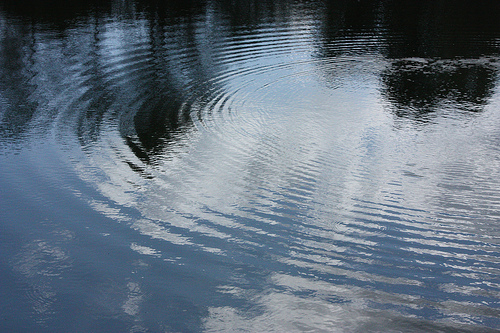
Interdependence –  In systems theory, the idea of interdependence refers to the fact that a change in any part of the system impacts other parts.  These impacts can be big or small, but they are there.  Again, looking at the example of a family, if I have a bad day at work and go home in a grouchy mood, this is going to impact the other members of my family, even though my work life is not theirs.  Oh my gosh! How connected is this to what many writers about yogic thought have to say?  I don’t even know where to begin!  Everything I do is connected to that universal.  Every action I take impacts the world, like a pebble dropped into a pond that ripples far into the distance.  Even within the body, the breath affects the heart affects the muscles affects the tendons affects the joints and so on.  It’s all connected – it’s all related.

Non-summativity – The most basic way this could be defined is that, when it comes to humans, simple addition will not work to understand a system.  We are right now in the middle of a crazy sports season in Philadephia.  Sports teams are a wonderful example of this principle at work.  You can put 9 “ok” baseball players on the field at once and instead of getting just an “ok” team, somehow you get an amazing team.  Or, you can put 9 outstanding players on the field and somehow end up with just an “ok” team.  At the most basic level, you + me ≠ 2.  We are at least = 3 (you, me, and our relationship).  This is so true from the perspective of yoga philosophy as well.  Think about the eight limbs of yoga.  If we add those things together, we get more than the simple sum of them.  We get something that goes far beyond.  As we sit in a yoga class and OM together, the energy that occurs in that space can take us somewhere that is different than simply a group of people who happen to be practicing yoga in the same place.

Equifinality – This concept of systems theory pretty much means that the path of a human system is not predictable.  Two systems can “begin” in the same place, but “end up” somewhere different and the reverse is true as well.  While we are certainly impacted by our history, we are not bound by it.  While we may be able to make some predictions about the future, they are as likely to be wrong as they are to be right.  Imagine two happy newlywed couples getting married today.  If we check in on them a year from now, their situations are likely to be quite different from one another.  Yogic thought tells us to focus on the now.  The past – it is past.  There is naught that we can do about it (and in all likelihood we are recreating it as we remember it anyway).  The future does not yet exist and to attempt to predict it is futile.  Now is where our attention belongs – in this moment, in this time, in this place – mindfulness of what is going on right now.  A review of all of the different paths and practices of yoga also shows us that there are multiple paths one can trod to move toward an ultimate goal of enlightenment/liberation/unification.

Praxis – And last, but not least, comes praxis.  Praxis is the idea that we are both the subject and object of our own actions.  Everything we do comes back to us in some way.  Every choice we make impacts the future choices available to us.  Praxis also encompasses the idea that through our actions we create the situations that then become our reality – so we create the reality that exists for us.  Karma!  This is karma (though I suppose I wouldn’t be so likely to teach it to my university students with that term).  The idea behind karma is that all that we send into the world – good, bad, or in-between – comes back to us in some form.  Dig it?

I could go on, because I’m really grooving on this connection, but I suppose this post has gotten quite long enough.  It’s just very cool to see another example of two completely distinct areas of study of human experience have come to similar conclusions through different paths.  Nice!

Food for thought, eh?

Namaste,

L