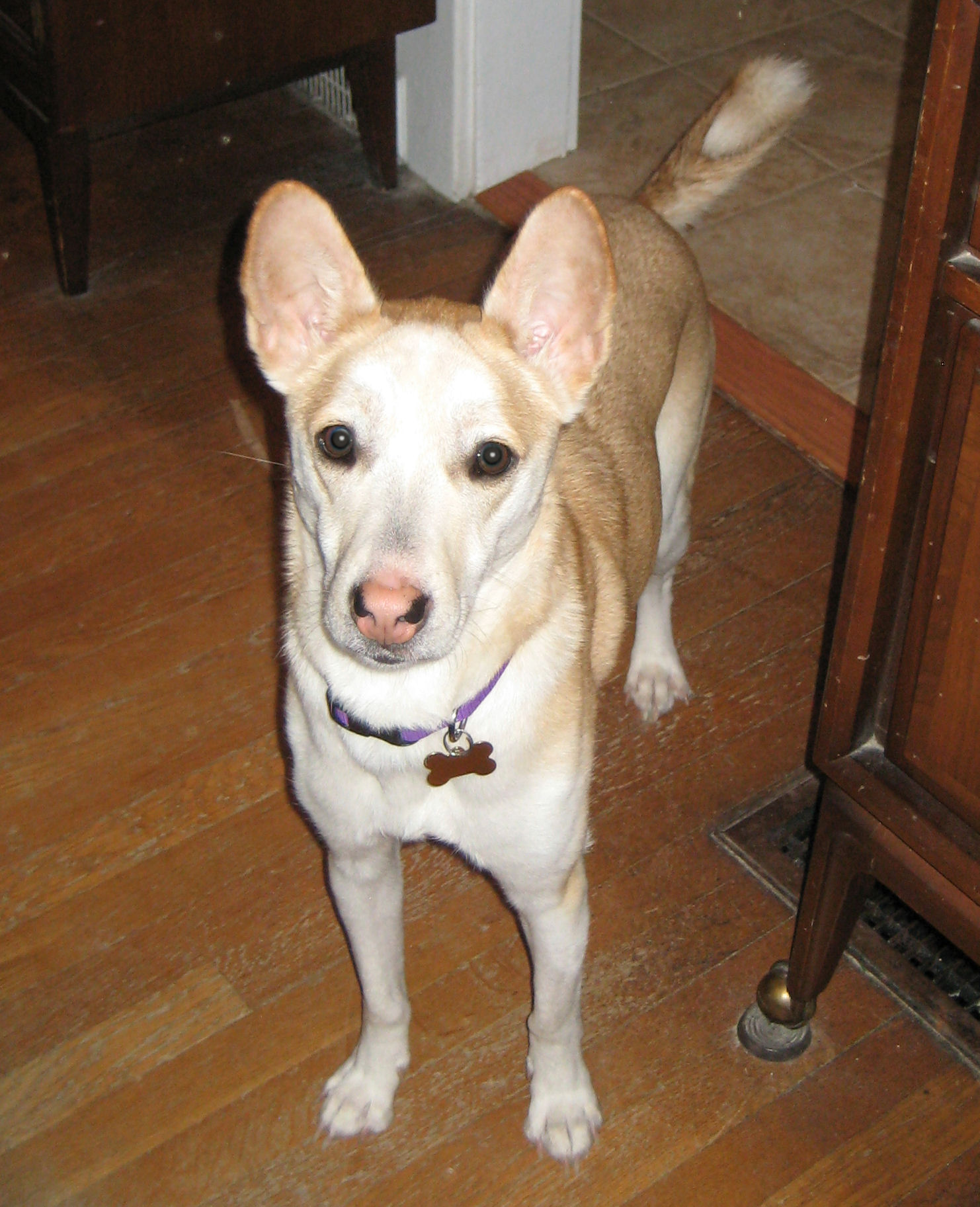
Upward Facing Dog on My Mat

We celebrated our daughter’s 16th birthday today with a hayride, pumpkin picking, caramel apple making, and dinner at Benihana.  So, I got back too late to go to my usual Sunday night Yin class.  After I digested, however, it seemed like a pretty good opportunity for a gentle home practice, and my younger (10) daughter was looking at a loss about what to do, so I invited her to join me – which was good, because it made me less self-conscious about speaking through the poses.

We started with a short seated meditation.  At this point, one of our dogs, Indy, placed herself squarely on my mat in a lovely sphinx pose.  After physically removing her from the mat, I settled back in.  Within seconds, she was on my daughter’s mat, laying on her legs during our meditation.  Hmmm…

From the seated position, we moved into a warm-up consisting of a variety of seated stretches and twists, moving into cat-cow, and finishing by coming up through Adho Mukha Svanasana into a standing position (Tadasana).  Since there was still a dog on the mat, I took advantage of the moment to ask my “student” what had worked for her in the warm-up and what didn’t work so well.  She gave me a little constructive feedback, and then we shooed the dog away and got ready to do a step back flow.

At this point, we proceeded into a step back flow consisting of:

  • Tadasana
  • Udhva Hastasana
  • Uttanasana
  • Ardha Uttanasana
  • Lunge
  • Lunge with chest lifted
  • Adho Mukha Svanasana
  • Plank
  • Asta Pranam
  • Bhujangasana
  • Adho Mukha Svanasana
  • Lifted foot
  • Lunge
  • Lunge with chest lifted
  • Uttanasana
  • Urdha Hastasana
  • Tadasana

We got through 2 series of flows (on each side), but not without some trials and tribulations, primarily related to a dog that WOULD NOT move.  I mean this animal was seriously plastered to the mat. She did not even care when my daughter was actually in Bhujangasana on top of her, she didn’t move.  And our attempts to move were for naught, as she only followed us.  It was funny, but maybe not quite the centered experienced we were going for : )  Besides the dog, my biggest challenge was to fit everything I needed to say into the space of a breath.  Whew!

After the flows, we quickly moved back to a meditative seat, as that seemed like the best option with our little helper on the mat.  We spent about 10 minutes in a cross-legged seat, concentrating on the flow of the breath.  This apparently worked well for at least the dog, who looked almost comatose by the time we finished.

All in all, maybe it wasn’t the best home practice I’ve had, but it was one, and it was nice.  I’m hoping to fit at least one more in this week with my studio classes and other obligations – maybe not including the dog or child!

Namaste,

L

Home Practice is Difficult

I have an admission to make.  I didn’t do a “real” home practice this week.  Sure, I did 10 minutes of seated meditation here and there.  I almost always do some seated stretches and standing folds at some point in the day.  And, I usually end the day with a little pre-bed asana.  But, I didn’t get to a dedicated full-on home practice.

So, what is the problem?  What is in my way?  I suspect that the things that get in my way are not unique to me, so perhaps a little reflection on what the blockages are is in order.

  • Time – Time gets in my way for home practice.  Currently, I have a vinyasa, yin, or teacher training class scheduled for every day of the week.  Then I have work Monday-Friday and every other Sunday.  Then there are family commitments.  It’s hard to find a good time to fit the practice in, and this relates directly to…
  • Prioritization – Going to class, cooking for my family, going to work – in all of these things I feel an obligation to others.  I feel like I have let someone down if they don’t get done or don’t get done well.  Guilt is a motivator for me (probably sadly) to be sure that all of those things fit into my day.  But, a home yoga practice is just for me – no one else.  So, it’s easy to push it aside and leave it for the “leftover” time.
  • Distraction – In a studio class, I can easily focus, because everyone there is doing the same thing and there aren’t competing activities going on.  At home, I can hear the laundry (that I need to switch over), the kids having that argument (that I need to solve), the whining dogs (that I should take out).  It’s insanely easy to come to the mat and then distract myself so much that I don’t really even get started.
  • Uncertainty – I’m still not sure what to do in a home practice.  When I do my home practice, I typically do a modified ashtanga practice, because it is all I can think of to do.  That’s fine, but I can pretty quickly zip through the poses I am “up to” in the primary series and have only done a very short practice.  I’m hoping that as training continues, I will feel more comfortable with my own ability to put together a practice for even myself.

These are the biggies for me.  I know I need to get past them, because it’s necessary for my own practice and for teacher training.  So, in the coming week, I vow to get’er done.

How about you?  What gets in your way for yoga practice at home?  Or, if not, what do you love about it?

Namaste,

L

What is Yoga?

For our second paper in yoga teacher training, we had to answer the following questions: What is yoga? What resonates for you? What challenges you? Are there examples of liberation in our culture that inspire you? How would you explain yoga to a brand new student? Here, I share my answer with you.

Atha yoganusasanam. The question of exactly what yoga is depends upon the particular school of thought from which you approach yoga. However, I would argue that all of these definitions share a common view of yoga as a uniting, and this is what yoga represents for me (more on that shortly). Some perspectives of yoga, for example Jivamukti, posit the unity as one between the practitioner and God. The practices of yoga serve as a vehicle through which one might achieve the yoking of the individual to the divine. Some perspectives, for example Ananda, focus on the increased unification with the wider spiritual consciousness. Iyengar yoga (and some might say Bikram and Power Yoga) address the union of the mind and body, such that they become one. The differences between styles, perspectives, and practices range from subtle to extreme, but it seems to me that the thread of unification is woven through all, and it is this that yoga represents to me.

If asked to explain yoga to a beginner, I would likely say that yoga is a process by which we achieve unity – unity of body and mind, unity of intellect and spirit, and unity with the universal life force. I first began yoga as a physical practice, to ease RA joint pain and develop the muscles around the joints for greater support. As I practiced, following the directions of instructors (on videos at that time), I didn’t consciously pay much attention to any information about the spiritual or meditative aspects of yoga. But, over time, I noticed that when I practiced regularly, I felt more calm, more able to “go with the flow,” and less stressed about myself or others. Eventually, this caused me to start really thinking about what it was in the yoga practice that created these changes for me. Around that same time, I started to attend classes “in real life.” Instructors of those classes spoke more about the spiritual and meditative aspects of yoga, and this, in combination with the changes I was seeing in my own being, encouraged me to read and study more of the philosophy of yoga, and to begin develop my own understandings of it. This view of yoga is something that I have come to gradually over the last few years, and I cannot say that I don’t still find parts of it challenging, as well as compelling.

The ideas of unity with others, connection between all life forms, and a universal life force that flows through us all resonate strongly for me. When I consider, read about, or discuss these ideas, I feel a sense of calm and connection that is wonderful. I am strongly compelled by the idea of liberation – liberation of all voices, all beings, all realities. I believe that we must respect, accept, and protect the lives around us, as we seek to grow in our connections with the universal. The Dalai Lama says: “Today, more than ever before, life must be characterized by a sense of Universal responsibility, not only nation to nation and human to human, but also human to other forms of life”

Buddha

Photo by EverydayBalance

While some ideas of yogic philosophy and thought resonate strongly for me, I find that I am still challenged by ideas of the essential self, or the divine expressed as a god/goddess. I’ve spent many years of my life being philosophically trained that there is no essential self. If we were to strip away the veils of culture and belief, there would be nothing left but perhaps the physical. So, when I am in a class and the instructor addresses the notion of breaking through the layers to reach the “real” self, I get sort of… antsy. I’ve also spent much of my adult life working through my understandings of divinity, realizing over time that I experience discomfort in any “embodiment” of divinity in a God (or gods) of any form. Working through how this belief relates to the philosophies and histories of yoga will, I think, continue to be a challenge for me.

That which resonate and that which creates dissonance are not opposites. They are part and parcel of the same (like light and dark, or joy and sorrow). In my own path, I look forward to continuing to examine these issues. And, I look forward to sharing this experience of examination, reflection, and unification with my students some day.