What is OM?

Our third paper for yoga teacher training was about OM.  Here, I share my answer with you.

What is OM?  What has your experience of it been?  Explain its mystical significance in your own words.  Provide one example of how you would introduce it to a class.

OM is the universal sound.  It represents what is known and what is unknown.  It exemplifies the connection of all parts of life, and all lives, and the greater force (whatever that might be).  As such, it makes an excellent way to begin and end a yoga class, to surround the practice dedicated to that connection.  While there are also many more specific religious connections that can be made, I tend to focus my attention on the broader issues of connection, and – particularly in a class where I didn’t know the students well or where they likely have different views of spirituality – this is what I would address as a teacher.

Though I started practicing yoga several years ago, I did not OM until I attended my first Yogawood class.  The class, which was an evening class, began with both a chant and an OM.  I remember feeling awkward and uncertain.  I can talk your leg off, but I do not sing in public.  I was told in sixth grade by the choir teacher that I was tone deaf, and I remember it to this day.  J  So, singing, other than silly singing in the car or in my house with the kids, is just not something that I do.  Even when called upon at university functions to sing the National Anthem or the Alma Mater, I simply mouth the words.  This was also my strategy for that first OM.  I did it, but with no sound.  I wasn’t going to embarrass myself with a bad sounding OM.  But, after I heard the OM done by the others in the class and the instructor (Beth), I realized a few things.  One, there were a lot of different voices in different pitches and tones and no one seemed to be concerned about what anyone else sounded like, or about whether they or others were “in tune.”  Two, something in that sound had spoken to me, had resonated both in my mind and in my body.  So, at the end of class, I gave it a whirl and learned that I very much like to OM.

To me, this sound at the start and end of a yoga class performs a number of functions, pragmatic, mental, and spiritual.  It physically brings me into the room in a way that I don’t know could be accomplished by anything else.  It fills my physical senses in a fashion that will not be ignored.  I hear the OM in my ears; I taste the OM in my mouth; I feel the OM vibrate in my chest and my throat – and then I’m right there.  The only thing I can really compare it to is the feeling of hearing a really good band play a really good song (with a lot of bass), live – – that vibration that happens in your sternum and just resonates up to your head and down to your toes and makes you feel like your whole body is playing with the music.   This physical fullness also clears my mind of other things very effectively.  I can sing (alone, in the car) without paying any attention to what I’m singing, but OM is different.  It’s almost as if it sweeps my mind clean of other thoughts.  And, finally, OM makes me feel a connection that is, and I mean this in the old English way, awesome.  The sound of OM feels like a set of threads that are connecting my being to all others being gently plucked.  Awesome.

When teaching students unfamiliar with OM about it, I would introduce OM by noting that it is a symbol and sound that has significance in a large number of cultural and spiritual views.  I would note that this may well be partly because it is a “universal” sound – in that it is made up of noise components that are likely to be among the very first sounds uttered by an infant in any culture.  This may be why this word has such resonance for many, because it harkens back to our earliest experiences in this life.  The singing of OM in a class can serve to center the mind on the present moment; it can bring us together, through the interweaving of voices and breaths; and it can remind us of our universal connections to all and that what unites us is greater and more fundamental than what divides us.  And so, we begin class with an OM, to be here, all of us, together.
Human Systems Theory and Yoga Philosophy

In my interpersonal and family communication classes, I always teach about human systems theory.  I’m a fan of this approach, because it resonates with  me and because it makes sense in the context of communication.  It’s been very interesting, as I’m reading more and more about yoga philosophy, to see how connected the two sets of ideas are.  Really, they say largely the same thing, just with a different set of foci and different terminology.  In this post, I consider the five basic principles of human systems theory and relate them to what I have been reading about the philosophy and theory of yoga.

The basic idea behind human systems theory is that when considering humans, individually or in relationships, all combinations and relationships can be understood using the same overarching theoretical lens, because they are all systems.  Regardless of whether we are talking about one individual, a couple, a family, a classroom, a workplace, etc., each will exhibit the characteristics of a human system, and can be understood in that way.  The five primary features of human systems are:

Wholeness – This is the notion that when parts of a system come together, they take on a “being” that goes beyond any individual and characterizes the whole.  A family is a nice example of this idea in systems theory.  You can think about the individuals in your family, but you can also think about the family as a whole, a thing in and of itself.  It may change with the addition or subtraction of members, but it remains the family.  This concept certainly relates to the idea of the universal being or universal connectedness that is often spoken of in yoga philosophy.  While we may think about each person individually, we are all connected in this overarching oneness that is always there.  It also relates to the connections between the mind, body, and spirit, which may be easily separated in our logic, but are really so interwoven as to be functionally inseparable.

Image by Sweet Little Lies

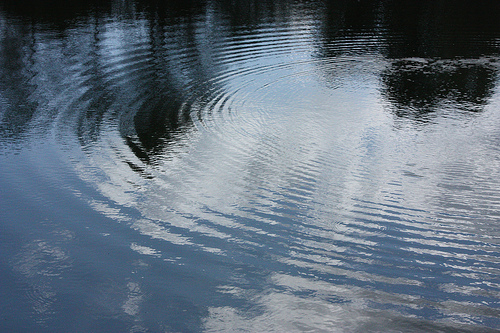
Interdependence –  In systems theory, the idea of interdependence refers to the fact that a change in any part of the system impacts other parts.  These impacts can be big or small, but they are there.  Again, looking at the example of a family, if I have a bad day at work and go home in a grouchy mood, this is going to impact the other members of my family, even though my work life is not theirs.  Oh my gosh! How connected is this to what many writers about yogic thought have to say?  I don’t even know where to begin!  Everything I do is connected to that universal.  Every action I take impacts the world, like a pebble dropped into a pond that ripples far into the distance.  Even within the body, the breath affects the heart affects the muscles affects the tendons affects the joints and so on.  It’s all connected – it’s all related.

Non-summativity – The most basic way this could be defined is that, when it comes to humans, simple addition will not work to understand a system.  We are right now in the middle of a crazy sports season in Philadephia.  Sports teams are a wonderful example of this principle at work.  You can put 9 “ok” baseball players on the field at once and instead of getting just an “ok” team, somehow you get an amazing team.  Or, you can put 9 outstanding players on the field and somehow end up with just an “ok” team.  At the most basic level, you + me ≠ 2.  We are at least = 3 (you, me, and our relationship).  This is so true from the perspective of yoga philosophy as well.  Think about the eight limbs of yoga.  If we add those things together, we get more than the simple sum of them.  We get something that goes far beyond.  As we sit in a yoga class and OM together, the energy that occurs in that space can take us somewhere that is different than simply a group of people who happen to be practicing yoga in the same place.

Equifinality – This concept of systems theory pretty much means that the path of a human system is not predictable.  Two systems can “begin” in the same place, but “end up” somewhere different and the reverse is true as well.  While we are certainly impacted by our history, we are not bound by it.  While we may be able to make some predictions about the future, they are as likely to be wrong as they are to be right.  Imagine two happy newlywed couples getting married today.  If we check in on them a year from now, their situations are likely to be quite different from one another.  Yogic thought tells us to focus on the now.  The past – it is past.  There is naught that we can do about it (and in all likelihood we are recreating it as we remember it anyway).  The future does not yet exist and to attempt to predict it is futile.  Now is where our attention belongs – in this moment, in this time, in this place – mindfulness of what is going on right now.  A review of all of the different paths and practices of yoga also shows us that there are multiple paths one can trod to move toward an ultimate goal of enlightenment/liberation/unification.

Praxis – And last, but not least, comes praxis.  Praxis is the idea that we are both the subject and object of our own actions.  Everything we do comes back to us in some way.  Every choice we make impacts the future choices available to us.  Praxis also encompasses the idea that through our actions we create the situations that then become our reality – so we create the reality that exists for us.  Karma!  This is karma (though I suppose I wouldn’t be so likely to teach it to my university students with that term).  The idea behind karma is that all that we send into the world – good, bad, or in-between – comes back to us in some form.  Dig it?

I could go on, because I’m really grooving on this connection, but I suppose this post has gotten quite long enough.  It’s just very cool to see another example of two completely distinct areas of study of human experience have come to similar conclusions through different paths.  Nice!

Food for thought, eh?

Namaste,

L

Upward Facing Dog on My Mat

We celebrated our daughter’s 16th birthday today with a hayride, pumpkin picking, caramel apple making, and dinner at Benihana.  So, I got back too late to go to my usual Sunday night Yin class.  After I digested, however, it seemed like a pretty good opportunity for a gentle home practice, and my younger (10) daughter was looking at a loss about what to do, so I invited her to join me – which was good, because it made me less self-conscious about speaking through the poses.

We started with a short seated meditation.  At this point, one of our dogs, Indy, placed herself squarely on my mat in a lovely sphinx pose.  After physically removing her from the mat, I settled back in.  Within seconds, she was on my daughter’s mat, laying on her legs during our meditation.  Hmmm…

From the seated position, we moved into a warm-up consisting of a variety of seated stretches and twists, moving into cat-cow, and finishing by coming up through Adho Mukha Svanasana into a standing position (Tadasana).  Since there was still a dog on the mat, I took advantage of the moment to ask my “student” what had worked for her in the warm-up and what didn’t work so well.  She gave me a little constructive feedback, and then we shooed the dog away and got ready to do a step back flow.

At this point, we proceeded into a step back flow consisting of:

  • Tadasana
  • Udhva Hastasana
  • Uttanasana
  • Ardha Uttanasana
  • Lunge
  • Lunge with chest lifted
  • Adho Mukha Svanasana
  • Plank
  • Asta Pranam
  • Bhujangasana
  • Adho Mukha Svanasana
  • Lifted foot
  • Lunge
  • Lunge with chest lifted
  • Uttanasana
  • Urdha Hastasana
  • Tadasana

We got through 2 series of flows (on each side), but not without some trials and tribulations, primarily related to a dog that WOULD NOT move.  I mean this animal was seriously plastered to the mat. She did not even care when my daughter was actually in Bhujangasana on top of her, she didn’t move.  And our attempts to move were for naught, as she only followed us.  It was funny, but maybe not quite the centered experienced we were going for : )  Besides the dog, my biggest challenge was to fit everything I needed to say into the space of a breath.  Whew!

After the flows, we quickly moved back to a meditative seat, as that seemed like the best option with our little helper on the mat.  We spent about 10 minutes in a cross-legged seat, concentrating on the flow of the breath.  This apparently worked well for at least the dog, who looked almost comatose by the time we finished.

All in all, maybe it wasn’t the best home practice I’ve had, but it was one, and it was nice.  I’m hoping to fit at least one more in this week with my studio classes and other obligations – maybe not including the dog or child!

Namaste,

L