Heating Up and Steeping for Time.

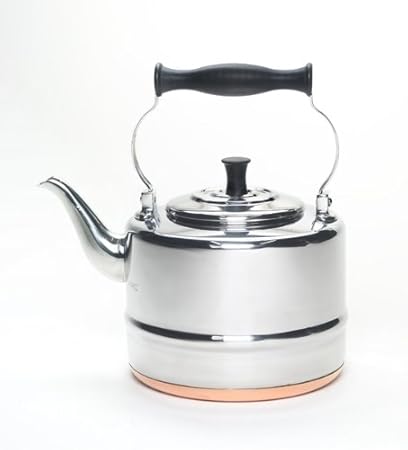
I’ve been searching for a tea kettle for a while now.

It seems like this should be a very easy task, but thus far it hasn’t been. I can find kettles that have decent reviews, but are not appealing or are so modern they will look silly in my kitchen. I can locate kettles that look gorgeous, but are priced outrageously. I can see kettles that are medium priced and lovely, but are glass and likely to shatter. Many kettles seem to suffer from rusting, flaking, or peeling, and longevity is an issue.

It all makes me wonder why it is so challenging to find the perfect tea kettle, and why I am so intent on the perfect tea kettle.

At the bottom, a tea kettle is only a mechanism to  heat water. I could do this in the microwave. I could use a pot on the stove. Yet, there seems to be a need for a kettle to heat the water the right way.

Making tea is complicated, like making life.

The tea kettle is but one component of making tea, but it’s an important one. The water needs to be sufficiently hot, but not so hot that it causes the tea to become bitter, or so over-boiled that it takes on the taste of the pot. Without the appropriately heated water, you simply cannot make good tea.

Similarly, in our day to day lives, we need to generate a certain amount of tapas (heat, energy) in order to create change or accomplishment. Without this heat, we can easily become like still water – stagnating, flat, taking on the flavors of our routine.

Sources of tapas, like a good tea kettle, aren’t always easy to find. Sometimes I know that I need to move or change or do, but I am inert. I see that my routines aren’t serving me, and my plans are in need of either revision or action if I am to help them unfold, but I fall right back into the same pattern. I literally get up at the same time, go to bed at the same time, attend the same yoga classes, socialize (or not) with the same people. Even where I’m not happy with these patterns, sometimes I get stuck in the phase of looking for a source of tapas to heat things up and get them rolling/roiling.

Other times, the source of tapas comes suddenly or unexpectedly. The big pile of work that needs to be done is there, and I know it. But, I find myself pushing it to the edges of my desk and my mind and instead surfing the net or flipping TV channels (often at the same time while I try to go to sleep). And then an announcement of a deadline arrives, and it’s soon! Somewhere in my head I knew it was coming, but I had been avoiding it. Suddenly there is fire under the kettle and things heat right up. The challenge then becomes preventing the pot from boiling over.

But, even when I do manage (sometimes through my own efforts and sometimes through external factors that seem largely out of my control) to get the molecules moving, there remains the challenge of not becoming so focused on the end that the process is lost.

When making a good cup of tea, the “end” is an empty cup. But, along the way, time is needed to steep the tea, carefully and slowly and with attention. Otherwise, it’s gone and all that is left is a bad taste in the  mouth, vague dissatisfaction, and the sense of a job poorly done.

In my life, it can be this way too. The catalyst strikes, energy to get the task done builds, and I’m underway. If I don’t catch myself there and turn things down a little, it’s pretty easy for me to rush through what I am doing. And then I either make a mistake, do a poor job, or miss the whole experience.

Sometimes this results in “little bads.” For example, in a rush this week, I poured icy water into my sinuses. That is not cool (actually, it was cold, but you see what I mean), but it wasn’t a big deal. Sometimes it results in “big bads,” like the wrong life path taken, or a bridge burned that can’t be rebuilt. I hope you’ll excuse me if I don’t give you an example of my big bads, but maybe you can think of some in your own life.

Perhaps, lately, this tea kettle is a metaphor for a bunch of other things going on, or not going on, in my life, and I’m fretting about selecting one because I don’t want to be pushed into action – my routine is comfortable. But, ultimately, change is one of the only certainties in this existence. Eventually, you have to heat the water. And for that, you need a kettle.

Fear, Guilt, Shame – Utility and Barrier in Yoga and Veganism

This week’s post brought to you a bit early by hurricane Sandy!

I’ve been thinking, writing, and talking (at a scholarly conference and in yoga classes) about fear, guilt, and shame quite a bit lately. And in those discourses, a theme that has wound its way throughout is that each has utility, but also can present a barrier to growth and wellness (n.b. I’m not going to provide the scholarly source cites here, but if someone needs them, let me know)  As we prepare for hurricane Sandy, taking the necessary precautions but attempting to avoid any freaking out about the situation, it seems a rather appropriate time to put these thoughts in blog form.

Fear is a part of our innate nature as animals. When we encounter situations that we perceive as threatening, the body and mind respond quickly to move into fight or flight mode. This gives us the energy we might need to get out of the situation or to deal with the threat. As we are impacted by things in life that harm us in some way, they are added to our bank of fear-producing events, and that helps to guide behavior in the future. Fear keeps us from doing things that are dangerous to us or to those we care about.

Similarly, guilt helps us to make choices about behavior. Guilt is a more social phenomenon, as it is built on societal precepts of what is acceptable, moral, ethical, and normal. When we stray from the bounds of acceptable, we are corrected in some fashion. From that, we learn what is acceptable and to feel bad (guilty) about straying, or even consider straying, from those expectations, and we use that information to make our life choices. Guilt helps to protect us from making choices that could be bad for others, or have serious social or personal ramifications for us.

Shame is connected to both guilt and fear, but is an entirely social phenomenon. We feel shame when we perceive that others would disapprove of our actions. The distinction between guilt and shame is slight, with the difference being that guilt is more about our own feelings that we are doing something wrong, and shame is about our belief that others would see what we are doing as wrong. While shame is probably of less utility, it does provide social protection that can be important in maintaining community relationships.

While these three facets of our humanity have useful roles in our lives, they can also be negative when they prevent us from the growth and change that is necessary for health, or confine us to narrow personal and social roles. In my life, they have unfolded in both helpful and negative ways in yoga and veganism.

I’m a vegan partly due to guilt and shame. Even from the time I was a small child, I realized that meat came from animals. I would eat hot dogs, sausages, ground beef, and lunchmeat without too much anxiety, but any food that came on a bone, or meat that was very chewy, presented a problem for me. When eating those things, I could not deny or ignore that what I was consuming came from the death of another being. I would get a piece of steak in my mouth and chew chew chew and not be able to swallow. Eventually, as an adult, I finally asked myself why I was continuing to eat meat if it made me so guilty and ashamed. It led me to a diet that has had benefits for me, my family, and probably a good number of animals.

At the same time, I could see how fear, guilt, and shame could become paralyzing in my dietary life. A while ago, a colleague pressed my diet choices, presenting some evidence of plants avoiding damage, and questioning whether I might want to think about how this could mean that plants have a degree of sentience. Similarly, I have had non-vegans lecture me on how the harvesting process inevitably kills insects. Stories of the dangers of soy can make it scary to consume that, as well. It would be easy enough to really take in all of this fear, guilt, and shame and become so conflicted that eating anything would be a trial.

In yoga, also, I have found fear to have its place. Fear of injury can prevent the ego from pushing me into poses that I’m not ready for, or that could be dangerous due to medical issues. Guilt and shame are not as useful, for me, in my yoga practice, but I will say that, now and then, it is feeling guilty about not practicing for a few days that gets me back on my mat. Thus, it can be a motivator in some cases.

Yet, fear, guilt, and shame can stop a person from growing and thriving in his/her yoga practice. I was speaking to a student the other day who has a strong yoga practice. She is dedicated to it and physically capable. But, fear keeps her from most inversions. And then she feels guilty that she is “being a baby” and not doing what she could do, and is ashamed when she perceives herself to be the only person in the room not kicking up to handstand. I know exactly what she is saying, because I’ve had this experience.

Sometimes, fear is not about “rational” or “real” danger.  For a long time, I felt very fearful in camel/ustrasana. I felt like I could not breathe and would begin to panic or not go into the pose at all. Clearly, I could breathe in reality, so there was no fear. And, even if I somehow really could not breathe in camel, I would have come out of it before I suffocated. More recently, I have found myself fearful of wheel. There is a little bit of the rational in this, because I am having a problem with my shoulders in the pose, but most of it is something emotional. It sometimes prevents me from going up into wheel even on days when my back and shoulders feel like they could handle the pose.

Guilt about yoga practice can be, sometimes in small doses, helpful to get us to the mat. But, beyond that, guilt may tend to prevent a practitioner from thinking through different possibilities of yoga. If I’m really busy feeling bad for not getting to a vinyasa class, it might prevent me from remembering that I can do some yin at home. If I’m not able or wanting to do any asana, guilt could get in the way of recalling that mindful meditation is yoga.

Yoga shame can be a powerful demotivator. When we start to worry about how our practice looks to others, and whether others think we are “good” enough or “dedicated” enough or “yogi enough,” it devalues the intrinsic good of the practice and makes it all about the public performance. All yoga practice is imperfectly perfect. It is the path and not the destination that is important, and shame can prevent us from remembering this.

Like so many things in life, fear, guilt, and shame are neither good nor bad. They just are. In any one instance, they can serve our goals and needs or push us further from them. I won’t say that the path is moderation (because, that too implies that there is a “right” level). So, instead, I will say that, when these feelings come up, they deserve some compassionate reflection, that we might use what is helpful to us and let go of what is not.

Namaste,

L

Misadventures of a Garden State Yogi – Book Review and Giveaway

This week, I received a review copy of Misadventures of a Garden State Yogi, by Brian Leaf. The book tells the tail of Brian’s experiments in travel, yoga, Ayurveda, and massage therapy (ahem), among other things. Wrapped into this story of a life, Brian provides the reader with the life lessons he has learned, connected to yoga philosophy, and suggests how those lessons might be utilized to improve life.

As all autobiographies suffer from the inherent problem of being a story of the self (that one has chosen to publish), thus implying a little taking oneself too seriously, or overestimating one’s own importance, it was delightful to open this book and immediately see the sense of humor with which it is written. Brian (yes, we are on a first name basis now – you can’t not be after you read the book) doesn’t hesitate to share some rather embarrassing stories, many of which resulted from times when he did slip into a bit too much pride in his own abilities.

The book could have just as easily been titled “misadventures of a Hoosier yogi” and been about someone from Indiana, as Brian’s story isn’t singular to New Jersey, but it did provide me with some additional enjoyment as a reader who lives in NJ to see areas that I know well mentioned.

This is a light read. If you want deep yoga philosophy, go with Michael Stone. If you want beautiful language and a deep feeling of zen, try some Thich Nhat Hanh. This is an amusingly written story about a “regular guy’s” search for himself and his physical, psychological, spiritual and social health. I wouldn’t (and won’t) hesitated to recommend it.

In fact, I like it enough that I want to share it with one of you! Simply reply to this post with what the title of your autobiography would be, and you’ll be entered in the contest. And the winner, selected by “And the Winner Is” widget, is Lynn.

And while you are at it, check out Brian’s website and his video contest. It would be pretty cool if a The VeganAsana reader could also win that cash.

Happy reading and seeking!

Peace,

L