It “Shouldn’t” Hurt, But Sometimes It Does

Image by Remara Photography on Flickr


If it hurts, come out of the pose.

Effort is fine, but you should not feel pain.


These are words that I have heard, and even said, in yoga classes many times. The basic idea is a very sound, because awareness of where the edge between effort and pain is prevents injury in yoga, as it does in other sports and activities. Additionally, it seems like pain is counter-productive to the more psychological or spiritual elements of yoga. However, as someone with a chronic pain issue, there is a little voice in my head that always says “but…” when I hear or say these instructions.

For me, a person with rheumatoid arthritis, yoga asana hurts. How much it hurts varies from week to week (or even day to day) and from one joint to another. But, it always hurts somewhere. The degree of pain can range from relatively unpleasant to the sort of pain that prevents me from practicing asana at all. But, there is almost always pain that is beyond a sensation of discomfort.

In class last night, every pose that involved pressure on my hands or wrists produced some degree of sharp pain. As you can imagine, this is a significant portion of the poses in a vinyasa class. However, I worked through it, because if I didn’t do vinyasas that caused pain, I would not be doing much vinyasa, and that’s not a place I want to be right now. I felt ok about having that pain while I was practicing, because this week it hurts to open an envelope, so I wasn’t surprised or alarmed to feel pain in downward dog. While I have read about pain-free yoga, I have never experienced it. I don’t say this to be dramatic or as a plea for sympathy. It’s just a reality for me in everything I do and thus it is part of my yoga practice.

I know I’m not alone. Many people experience chronic pain in one form or another, and some of those people are doing yoga (some do it as a way of dealing with chronic pain). Staying completely away from any sensation we might characterize as pain can be detrimental to achieving the benefits of yoga that can be gained for someone who has pain. But, that has to be qualified with a “within reason.” Working through some types of pain can result in exacerbation of the underlying conditions. It’s complicated.

You might be surprised to hear that I don’t have an answer to this issue (but not if you read here often, because I frequently don’t have a clear answer  – sarcasm alert).

I think the answer partly depends on what kind of yoga it is, and what the goal is. For a gentle yoga asana class or a class focused on relaxation, any level of pain or intensity might be too much. For a more physically active vinyasa class, or a yin class that can produce intensity for many people, we may need to expect that some students are feeling sensation they might characterize as pain and that this is ok, as long as the pain is not extreme, is not unusual, is not unbearable, does not produce dizziness or nausea, and is not in areas of the body that are very easily injured (e.g. knees) or where injuries could be quite dangerous (e.g. neck).

It also depends on the person. If the pain experienced causes the individual to clench up, to move a joint in an unsafe manner in an attempt to avoid the sensation, or to come “out of” the practice, then it is likely not advantageous to continue doing the poses that create that pain.

I think that part of the key here, as it is with so many things, is knowing the body. If I know my body well, then I’m better able to see where my edge is. It isn’t something that another person can ascertain for me. Some of that learning happens by going a little past that edge and feeling it after. Some of it happens by going a little past where you think the edge is and finding out that it isn’t really there. Some of it happens by learning to relabel some pain as sensation, or becoming more of a connoisseur of your own body sensations and thus knowing what feels like “normal” pain and what feels like “abnormal” pain, or what feels like a muscle or ligament pulling instead of some tension on a previously damaged joint. Yoga helps us to gain this kind of body knowledge.

The bottom line, for me, is that sometimes yoga asana hurts. That can be the sign of a problem, or it can be just a reality of the particular body doing the asana. As we can’t assume that anything will be experienced in the same way from person to person, we can’t assume that yoga shouldn’t hurt if it’s being done correctly.

Yoga and Service: A Practice for Self to Others

Photo: lwpkommunikacio

Life’s most persistent and urgent question is, “What are you doing for others?”
~ Martin Luther King, Jr.

It’s a metaphor (or simile) many of us have heard more than once. When you are seated on a plan and get the pre-flight safety speech, you are told that – should you be seated next to a child or someone who cannot care for him/herself – you should put on your own oxygen mask before you attend to the needs of others. And, this applies in so many other situations. For the purposes of this post, the bottom line is that you cannot help anyone else if you don’t take care of yourself, and yoga promotes and allows that.

I fundamentally believe this to be true.

I would say that I was a pretty good mother before yoga. But, I was a mother who raised my voice not infrequently. I was a mother who felt huge surges of frustration almost daily. I was a mother who often felt regret (and expressed it) over something I had said to, or in the presence of, my children.

Yoga changed me. While I’m certainly still imperfect (ask any of the six of them), I raise my voice pretty rarely. I am much more even-keeled about things. I don’t let my children push my buttons so easily and therefore I can respond to them with more equanimity. I still sometimes say things that I shouldn’t, but it’s much less frequent, and I still apologize when I do.

Maybe this is because of things I learned and embraced more fully having started my yoga journey: ahimsa, aparigraha, santosha, and so on. Perhaps it is partly because yoga also helped me to make my way more fully to Buddhism. But, some of it is because in caring for myself, showing kindness to me, I am better able to show kindness to others.

Family life and work, I think, for most of us are often more ‘winding up’ than they are calming. They combine with all of those expectations of self and others that we create in the social realm to create tensions and stresses that are felt in the mind and in the body. This is apparent after a tough week at work or at home when the body responds with back pain, tense shoulders, headache, and indigestion.

It’s not easy, in these environs to find a time or place to focus on letting some of that go – an indeed we may feel guilt if and when we do. Culturally, we are taught that our attention should be devoted to something beyond the self. For men, still, it is on power, success, career. For women, still, it is on the needs of children, of lovers, of family, and then of work. Even in a culture that is, in many ways, extremely individualistic, spending time on and for the emotional or spiritual needs of the self remains somehow suspect. But we need to be healthy in these ways before we can help anyone else.

By providing the time and place to let go of day-to-day obligations to other, the space to appreciate the basic abilities of the body, the room to embrace the connection to something larger than even our obligations to family, friends, and occupation, yoga brings us to a spot from which we can more easily heal the self. And from there, we have the mental, social, and physical resources to serve others. Obviously, that doesn’t always mean that we will, and an individual can do yoga asana with no intent to grow, change, or serve (though I sort of feel like if it’s done consistently and with others it might happen anyway), but it provides that opportunity.

Yoga can be the oxygen mask for the self. It may not be a sufficient condition to create service, but it makes it possible for service to others to develop.

So, maybe, on this day of service, you do a little yoga – of whatever form. And maybe you offer up the good energy generated by that practice to others. And maybe you remind yourself that what you do in practice, even when done all alone, can be toward the service of something greater.

My inSens – An Incense Lover’s Review

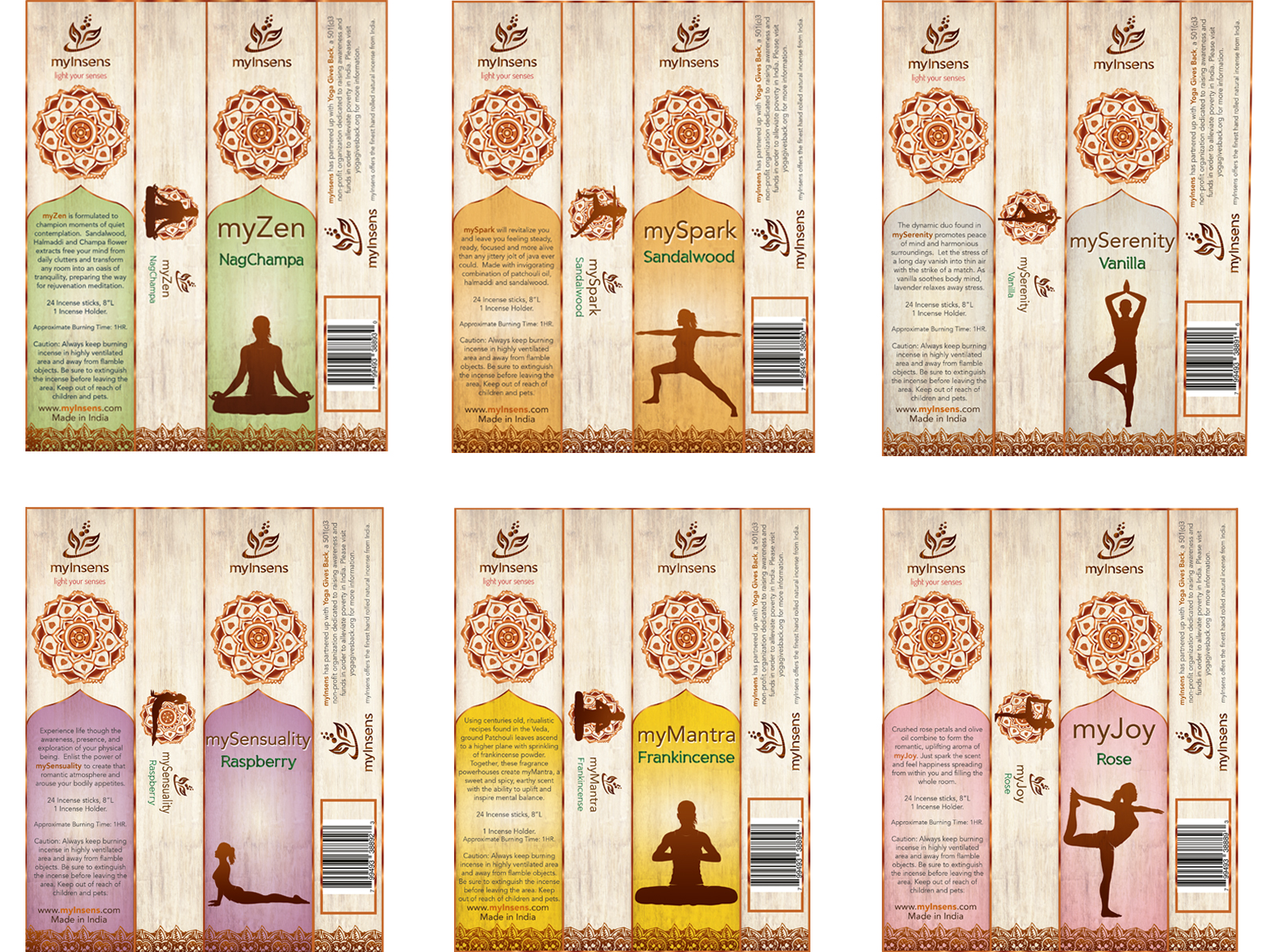
A few weeks ago, we received a complimentary trial package of incense from My inSens. After opening the very luxurious package, much of it disappeared into Ms. VeganAsana Jr.’s room. A young-adult lover of incense, she’s been burning it non-stop since then. What follows is her review, with my additional comments in italics.

Good incense should be more than just a candle replacement. When I light incense, I expect it to change the feeling of a room. And the incense from myInsens does that, and more. Started up in 2011 by Kaivan Dave, each incense aroma is attached to a specific emotion, be it happiness, serenity, or even sensuality. Each scent is relaxing, and a welcome change to my day.

All of the incense burn wonderfully—lasting, on average, about 30 minutes. But the smell lingers even longer. I can testify to this. Even when the incense was burned in G’s room, the upper floor of the house retained the scent for hours. This would make these incense sticks particularly good for studio use, as they could be burned, extinguished, and the scent would linger through a class. The scents are strong enough that, for some of them, I noticed that when my sinuses were particularly grouchy, it wasn’t a good idea for me to be close to the burning stick, but the scent from a distance didn’t bother me and was still pleasant.

Each aroma has a specific colour, to differentiate them from all the others. My personal favourite scent for the samples was myJoy, which is intended to boost positivity and generally make the user more joyful. It has a very pleasing rose-like scent, but one that isn’t too overpowering. Each of them has a certain subtleness that spoke of the high quality. MySensuality had a lovely raspberry undertone that was distinct from the usual incense smell.

But as nice as those smelt, the best “full-body” experience was found the most in myZen. One of the stronger, more traditional smells, it really provided me with a tranquil state of mind during my yoga practice. The scent blends with the atmosphere well, and it was the calmest I had been in a while.

Even the price is good. Though they are certainly more than your average drugstore or health-food store incense, but they do last somewhat longer in burning and definitely longer in smell. I had expected the incense to come at a price as rich as the aroma, but I was surprised. For twenty four incense sticks, it’s only fifteen dollars.

So for incense that smells great, is very reasonably priced, and really targets the points that I expect incense to accomplish? This is a completely fantastic find, and something I’m absolutely sure to buy again.

You can find myInsens at https://www.myinsens.com/