


 I’ve spent 45 years cultivating my “self.” I’ve developed pretty strong understandings of my characteristics and beliefs. I’ve established standards for my own behavior and defined what is and is not acceptable for me.
And yet, as a student/researcher of communication, I’ve long believed that the “self” is a socially created construct, which arises from our interactions with others. I’ve thought that standards of behavior, my own or someone else’s, are arbitrary and developed through culture.
More recently, as a yoga student, I’ve refined my notion that the attachment to the story of self (asmita) must be released in our process of becoming more connected with that which is universal. It makes sense to me that the emphasis on the me, the I, is counter-productive in cultivating union.
But… isn’t there always a but? But, it’s hard. It’s hard to let go of “me.” And I look around and see many other yogis having the very same problem. It’s hard not to attach to the stories you have built over time that explain the self. It’s hard not to feel and attach to a sense of personal accomplishment about what you can do (even in a yoga class, which has it’s own irony) or guilt/shame about what you cannot.
It all becomes more tricky, because there is an infinite regress of places where the “me” can pop up. Let’s say that you get comfortable with letting go of attachment to your sense of personal accomplishment regarding asana. Then the next level is to let go of the sense of accomplishment over having let go of the sense of accomplishment. Ouch. And it just goes on from there.
We also live in a world that will require you to create stories of you (what is a resume, after all), and will certainly create stories about you. That doesn’t mean you have to attach to the stories, but it does mean that you likely have to participate in them, and commit to enacting them, which makes it harder not to attach to them.
To some degree, the development of an understanding and set of beliefs about self is part of our humanity. Some scholars would say that the ability to abstractly understand and evaluate the self in relation to others and the world is what makes us human. Letting that go completely may not be possible, or desirable.
 Maybe a more reasonable goal is to cultivate awareness of when the story of me is cropping up in a way that prevents us from seeing our unity with that beyond, keeps us from opening up to other possibilities, stands between us and our ability to truly experience the present, and blocks us from being able to understand and empathize with the reality that others are living.
Namaste,
L
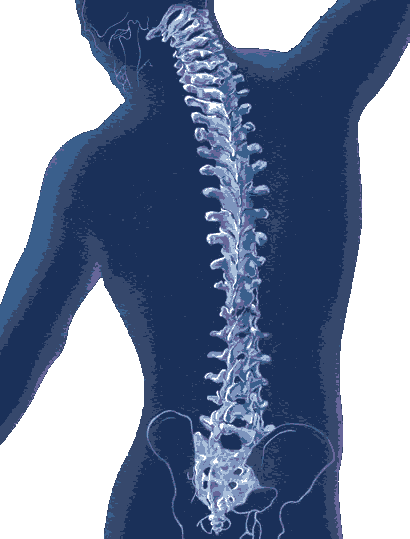
 This summer, I had some MRI testing done for an issue related to tremors. It was a little scary at the time, but the final diagnosis wasn’t too traumatic. However, the tests did reveal a hemangioma and 3 disc bulges (one neck and two lower back) on the spine. Being a well-behaved yoga student, I discussed the results with my primary instructor, Beth, and she made some recommendations for my practice. First, she suggested that I hold off on headstand for a while, and limit shoulder stand (using blankets and staying up for shorter times). Second, she asked me to try to avoid a lot of stressing of the lower back by rounding, instead working on greater length in that area. She made specific suggestions for that including bending knees more in forward folds, really working on the belly to spine during asana, and (the most DAH DAH DUUUUUUUM! for me) using plank pose instead of caturanga during vinyasa.

